On November 7, MediTrust Health hosted the “Innovation for Health—Forum on the Integration of Commercial Insurance and Value-based Healthcare” in the Medical Devices and Healthcare section at the 7th China International Import Expo (CIIE). Experts and scholars from the fields of healthcare, pharmaceuticals, and insurance gathered to discuss various topics, including “How to Meet the Diversified Medication and Treatment Needs of Patients”, “How Commercial Insurance Can Support Innovative Pharmaceuticals under a Multi-layer Payment Mechanism”, and “How Healthcare, Pharmaceuticals, and Commercial Insurance Can Collaborate for High-quality Development”. The forum focused on exploring new collaborative innovation models between medicine, pharmaceuticals, and insurance to accelerate the final mile of making innovative pharmaceuticals and medical devices accessible to patients.
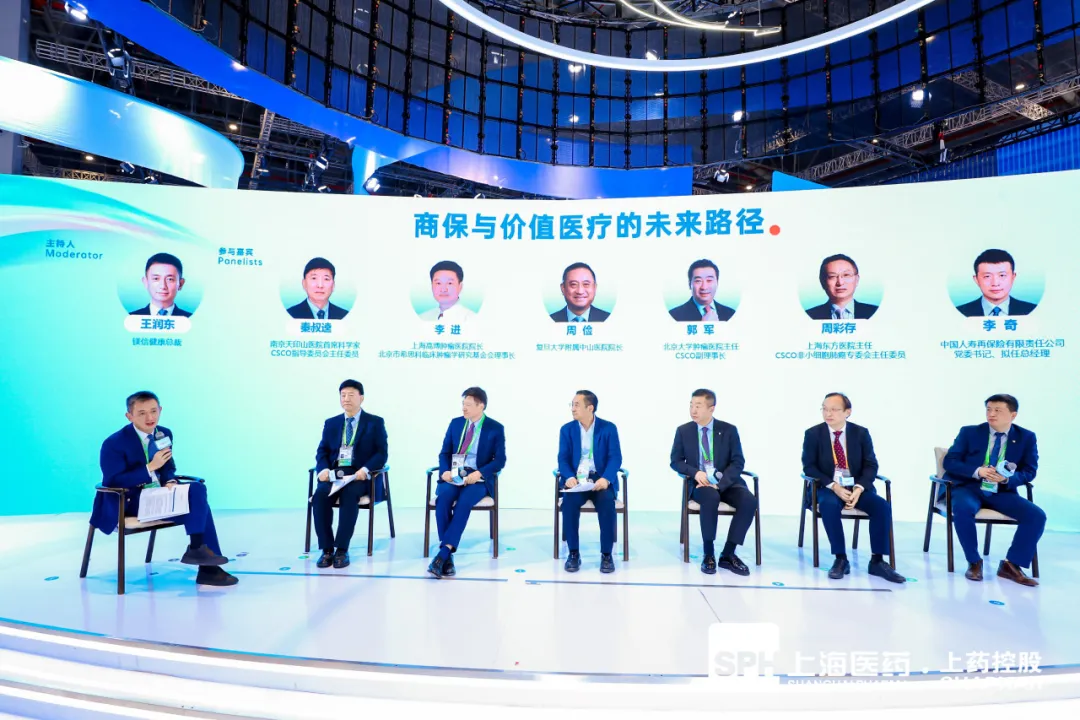
Qin Shukui, Chairman of the Steering Committee of Chinese Society of Clinical Oncology (CSCO) stated that under the support and guidance of national policies, China’s healthcare and pharmaceutical industries have flourished in recent years. With the increasing introduction of innovative pharmaceuticals, medical devices, and technologies, the public’s health awareness has risen significantly, and so have their expectations for healthcare services. This requires a multi-layered, diversified healthcare system. Therefore, alongside the implementation of national medical insurance that ensures basic coverage, it is essential to actively promote commercial health insurance to help realize the goals of “Healthy China” and benefit both the country and the people. The CSCO is committed to providing strong support and full engagement in this effort.
Li Jin, Chairman of Beijing Xisike Clinical Oncology Research Foundation, emphasized that China has made great strides in innovative pharmaceuticals compared to a few years ago based on the needs of the public, the efforts of the government, and the work of biopharmaceutical companies. However, after new drugs are launched, they account for only 4% of total medical expenses, and the issue of “unaffordable or inaccessible” medications persists. The public still needs alternative payment methods outside of healthcare security to avoid the risk of “falling into poverty due to illness” or “relapsing into poverty due to illness”.
It’s suggested by Zhou Jian, President of Zhongshan Hospital affiliated to Fudan University, that the development of innovative pharmaceuticals requires significant investment and often needs a proper incentive mechanism to sustain innovation. Under the condition of “broad coverage and basic protection” provided by basic medical insurance, commercial insurance must play a critical role in supporting payments for innovative drugs, allowing the public to access differentiated treatments. Moreover, commercial insurance can also promote the “pilot and pioneering” role of innovative pharmaceuticals, contributing to the achievement of “Healthy China”.
Guo Jun, Vice Chairman of CSCO, noted that Chinese innovative pharmaceuticals currently account for only 3% of the global market. In the race to catch up, it is crucial to provide sustainable development support for innovative pharmaceutical companies. A variety of diversified payment solutions are needed to offer a reasonable price for innovative pharmaceuticals, which will help promote the continuous development of these companies.
Zhou Caicun, Chairman of the Experts Committee on Small-Cell Lung Cancer of CSCO, stated that the rapid development of innovative pharmaceuticals not only allows more patients to “survive” but also enables them to “live with better quality”. With such excellent clinical research and high-quality products, patients still face the challenge of not being able to access them if the pricing and payment mechanisms are inadequate. Therefore, we need various payment methods to ensure more people can benefit from innovative pharmaceuticals, thereby improving prognosis of patients.
Li Qi, Secretary of the Party Committee and Prospective General Manager of China Re Life, shared his perspective from an insurance standpoint. He pointed out that commercial insurance has a responsibility to optimize patients’ healthcare pathways, improving the efficiency of medical treatments and pharmaceutical distribution. The insurance industry can deeply integrate with the pharmaceutical sector to build a “shared-risk” communication mechanism, better serving the public.
It’s stated by Song Ruilin, Executive President of China Pharmaceutical Innovation and Research Development Association (PhIRDA), that China’s biopharmaceutical development has reached a historical juncture where commercial insurance must be involved. Insurance companies and hospitals shall establish a system where they are both service providers and prescription regulators, ensuring seamless coordination with basic medical insurance.
Wang Rundong, President of MediTrust Health, emphasized that MediTrust Health has always been committed to helping patients address medical payment issues through innovative payment methods. We understand that high medical costs present a significant challenge for many patients, especially in the field of cancer treatment. The release of the consensus has effectively reduced claim difficulties caused by information asymmetry, increased financial support for patients, and enabled more patients to afford high-quality treatment plans, particularly those requiring advanced drugs and technologies. With the support of this consensus, medical services and commercial insurance will accelerate their integration for high-quality development.
At the conference, CSCO, Beijing Xisike Clinical Oncology Research Foundation, PhIRDA, China Re Life, and MediTrust Health officially initiated strategic cooperation. In the future, the five parties will collaborate closely on the deepening and expansion of doctor networks and healthcare service networks, and jointly develop the “Consensus on Commercial Insurance Medical and Claims Clinical Pathways”. It’s reported that this consensus will be based on the Guidelines for the Diagnosis and Treatment of Malignant Tumors issued by National Health Commission, the “CSCO Guidelines for the Diagnosis and Treatment of Common Malignant Tumors”, and will also reference domestic and international evidence-based medical data. It aims to provide clinical experts with more comprehensive and accurate treatment pathway support. Under the agreed-upon standardized treatment paths, the reimbursement scope and claims rules for commercial health insurance will be defined, supporting product pricing. Additionally, the collaboration will offer patients whole-course management, from payment to diagnosis and treatment, to access to advanced drugs and medical devices, ensuring they can truly enjoy high-quality healthcare services.





 电子营业执照
 沪公网安备31010402003664号@Copyright©MediTrust Health 2019